I worked at the St. James Campus from August 2018 – June 2026.
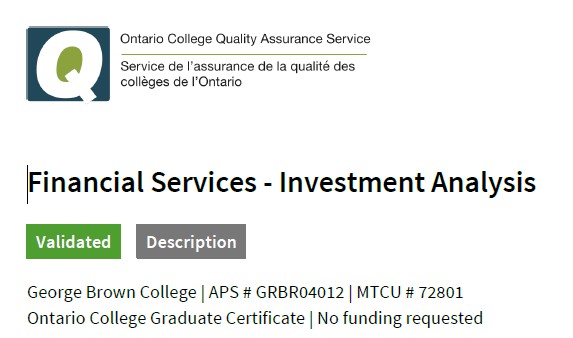
I was hired to set up, and was the Program Developer Lead for a CFA® based Ontario College Graduate Certificate: Financial Services – Investment Analysis.
I developed the curriculum, course outlines, and set up the relationship with Kaplan for exam prep licenses to complement official CFA Curriculum.
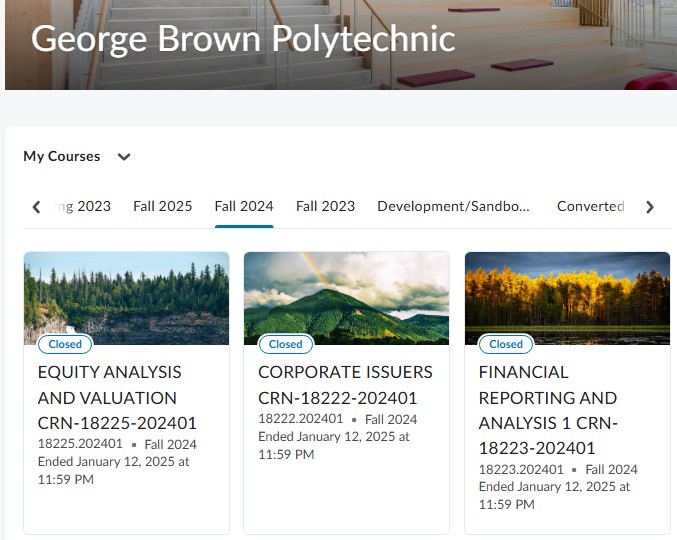
Program ran from Fall 2024 – Spring 2025.
27 Students. Almost all International.
Program suspended Fall 2025 due to decrease in International student visas to Canada.
I connected Group Head, Scotia Wealth Management to GBC for our students to be considered for Internship. Total Success. Contributors = FMI + Blog.
Financial Services – Investment Analysis
This is a two-semester program with a focus on preparing students for the Chartered Financial Analyst (CFA™) Level One (1) exam and with the professional and interpersonal skills to be successful in the field of investment analysis and management. The Chartered Financial Analyst™ designation is a professional certification offered internationally by the American-based CFA™ Institute to investment and financial professionals. This program focuses on the fundamentals of investment tools, valuing assets, portfolio management, and wealth planning. This graduate certificate is typically completed by those with backgrounds in finance, accounting, economics, or business. CFA™ charterholders are qualified to work in senior and executive positions in investment management, risk management, asset management, and more.
This program will confer an Ontario Colleges Graduate Certificate and prepare graduates for the CFA™ level 1 exam and concepts beyond the exam curriculum needed for success in the industry.
In 2017, I recorded over 500 CFA Level I videos for Apptuto, an Edtech that had 500 Startups Funding. I would estimate that 85% is still relevant for 2026 curriculum.
FPSB® Curriculum Development Contributions
Click on Image for Competency Profile
Click on Image for Competency Profile
Click on Image for Competency Profile
George Brown College
Teaching & Learning
Handbook
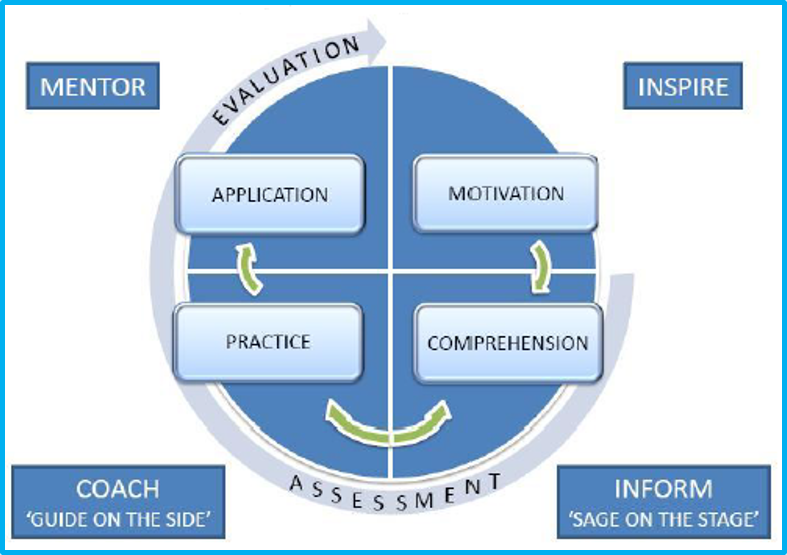
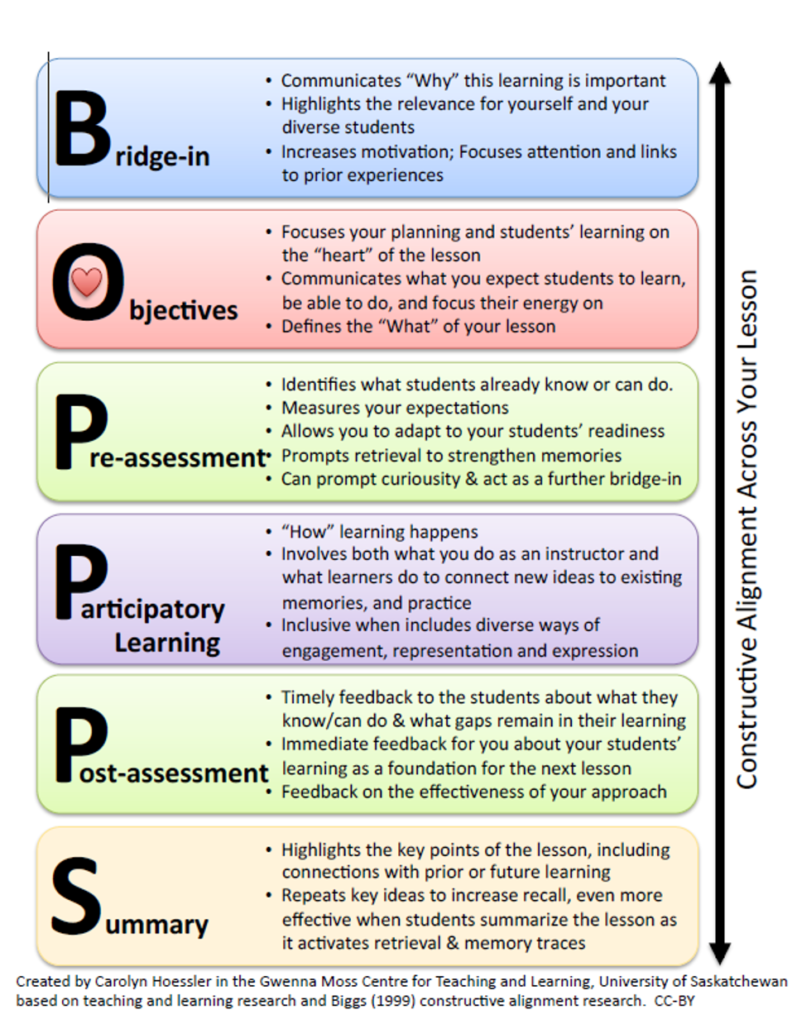
THE LEARNING CYCLE
GBC has a fantastic new teacher training. The Learning Cycle graphic is from a T&L Handbook. One sometimes needs to remind oneself to be that coach and mentor sometimes.
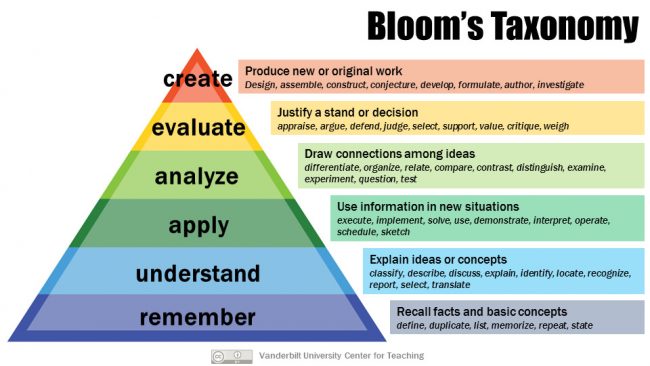
Bloom’s Taxonomy
The Revised Taxonomy (2001)
A group of cognitive psychologists, curriculum theorists and instructional researchers, and testing and assessment specialists published in 2001 a revision of Bloom’s Taxonomy with the title A Taxonomy for Teaching, Learning, and Assessment. This title draws attention away from the somewhat static notion of “educational objectives” (in Bloom’s original title) and points to a more dynamic conception of classification.
The authors of the revised taxonomy underscore this dynamism, using verbs and gerunds to label their categories and subcategories (rather than the nouns of the original taxonomy). These “action words” describe the cognitive processes by which thinkers encounter and work with knowledge:
Remember
Recognizing
Recalling
2. Understand
Interpreting
Exemplifying
Classifying
Summarizing
Inferring
Comparing
Explaining
3. Apply
Executing
Implementing
4. Analyze
Differentiating
Organizing
Attributing
5. Evaluate
Checking
Critiquing
6. Create
Generating
Planning
Producing
BOPPPS
The BOPPPS structure is an excellent one for group project presentations to divide the work and structure the presentation.