The 30-Year Mortgage
Canada has made an important change for first-time homebuyers.
Since December 15, 2024, eligible first-time buyers can obtain an insured mortgage with an amortization of up to 30 years instead of 25 years. Buyers of newly constructed homes can also qualify for the extended amortization. The government’s stated objective is straightforward: lower monthly mortgage payments and help more Canadians buy a home.
And it works.
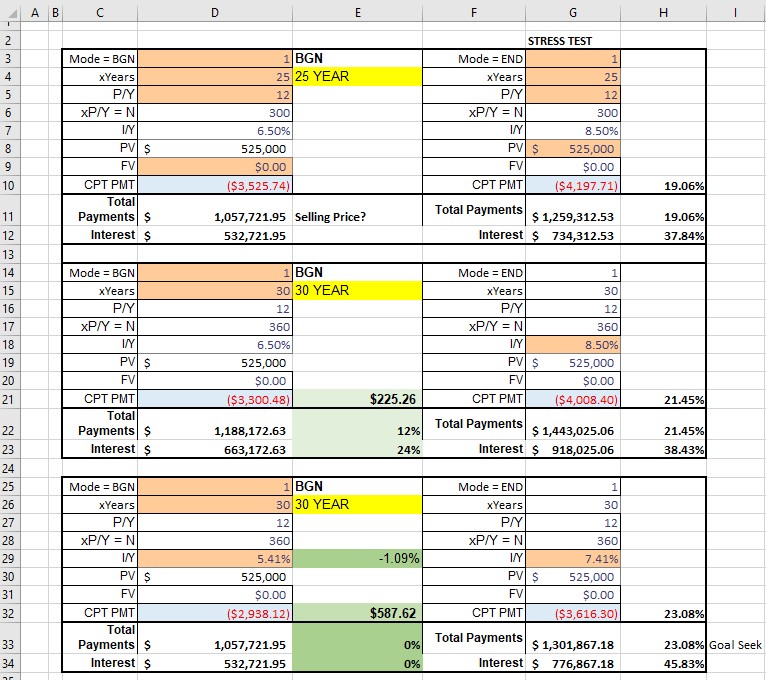
Consider my example of a $525,000 mortgage at 6.50%.
Over 25 years, the monthly payment is approximately $3,526.
Stretch the same mortgage to 30 years and the payment falls to approximately $3,300.
That’s about $225 per month of additional cash flow for the homebuyer.
But there is another side to the calculation.
If the interest rate remained at 6.50% for the entire amortization—purely as an illustration—the 25-year mortgage produces approximately $532,700 of interest, while the 30-year mortgage produces approximately $663,200.
The monthly payment falls—but lifetime interest rises substantially. So I tried a different question in Excel (TOOLS GOAL SEEK!)
What interest rate would make the total payments on the 30-year mortgage equal to those of the 25-year mortgage?
In my example, the answer is approximately 5.41%.
That’s 109 basis points lower and $587.62 per month less in payments. This really helps first-time buyers and keeps the financial institutions “whole” as at a 25-year rate.
This is not a government-mandated rate, nor am I suggesting lenders should price mortgages this way. It is simply a useful way of illustrating an important point:
Extending amortization creates cash-flow relief. But borrowers should understand the total cost—not just the monthly payment.
Sometimes the best mortgage question isn’t “What can I afford each month?”
It’s “What will this mortgage ultimately cost me?”
The government policy addresses amortization eligibility, but it does not prescribe a special mortgage interest rate for the 30-year option
(AI Disclosure – I do the excel – ChatGPT helps me write – I read and review as the expert). AIntern. Teddy & Tedai. My ideas – human led tech. 😉
Rent vs. Buy in Canada: What If You Actually Invest the Difference?
“Renting is throwing your money away.”
It’s one of those financial sayings we’ve all heard. And there is some logic behind it: when you own a home and make mortgage payments, you are gradually paying down debt and building equity.
What if renting costs substantially less than owning? And, more importantly, what if the renter actually invests every dollar of the difference? Let’s run the numbers.
Starting With the Same $525,000 Mortgage
To keep things consistent, I’m using the same mortgage from my previous analysis of the 30-year mortgage.
This time, however, we’ll use a 25-year amortization:
- Purchase price: $700,000
- Down payment: $175,000
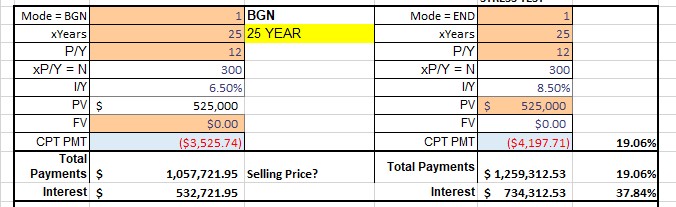
- Mortgage: $525,000
- Interest rate: 6.50%
- Amortization: 25 years
- Monthly mortgage payment: approximately $3,526
Over 25 years, assuming for illustration that the interest rate remained unchanged, the homeowner would make approximately $1.057 million in mortgage payments, including about $532,722 of interest.
That sounds expensive—and it is.
But at the end of those 25 years, the mortgage balance is zero and the homeowner owns the property outright.
Now Let’s Give the Renter a Fair Chance
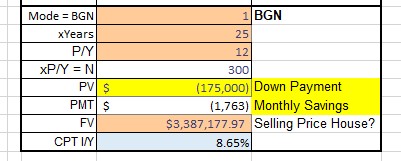
Suppose our renter can rent a comparable property for half of the mortgage payment—approximately $1,763 per month.
Instead of spending the other $1,763, our disciplined renter invests it every month. But there is another important piece of the comparison.
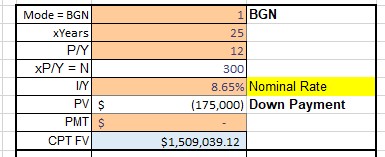
The homeowner started with a $175,000 down payment. If we’re going to compare the two strategies fairly, the renter gets to invest that $175,000 instead.
For our illustration, we’ll assume the investments earn a 8 – 9% annual compound return over 25 years.
That’s an assumption—not a prediction or guarantee. Investment returns fluctuate, sometimes substantially. Now let’s see what happens.
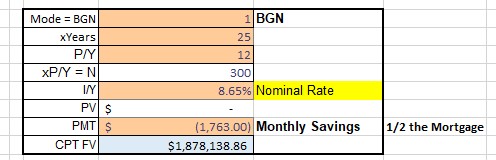
Those monthly contributions alone grow to approximately $1.878 million.
That’s the power of compounding – but remember what it requires: our renter must actually invest the difference, month after month, year after year.
What About That $175,000 Down Payment?
Our renter also has the $175,000 that the homeowner put into the property. Invested for the same 25 years at our assumed 8 – 9% annual return, that initial capital grows to approximately $1.509 million.
Combine the initial investment and the monthly contributions, and our renter ends the 25-year period with approximately:
$3.387 million
What Would the Home Have to Be Worth?
Our homeowner started with a $700,000 property. At the end of 25 years, the mortgage is paid off. So how much would that $700,000 house have to appreciate to equal the renter’s approximately $3.387-million investment portfolio? The answer is roughly:
6.32% per year
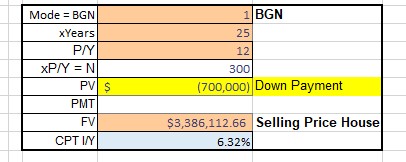
That is our break-even number.
If all of our assumptions actually occurred, the $700,000 home would need to appreciate at approximately 6.32% annually for 25 years to produce an ending asset value comparable to the renter’s investment portfolio.
But before anyone calls the real estate agent – or cancels the appointment – we need to talk about reality.
Spreadsheets Are Easy. Real Life Isn’t.
This is deliberately a simplified comparison. The homeowner has costs we haven’t included: property taxes, insurance, maintenance and repairs, and potentially substantial transaction costs.
Real estate values also fluctuate. We’re seeing a very real reminder of that in parts of Toronto’s condominium market today. An asset can have a positive long-term trend without increasing every year.
The renter isn’t living in a risk-free world either. Rent can increase. A tenant may have to move. Investment markets can decline sharply, and a 9% annual return is certainly not guaranteed.
And buying has another practical hurdle: you have to qualify for the mortgage. Canada’s mortgage stress-test requirements can prevent someone from qualifying for a mortgage even when they believe they could comfortably make the actual payment.
Sometimes renting isn’t an investment strategy. It’s simply the option available.
The Biggest Assumption May Not Be 9%
There’s another risk in our renter calculation that Excel can’t model very well: Human behaviour. Our renter has to invest approximately $1,763 every month for 25 years. That’s 300 monthly investment decisions.
No skipping contributions because there’s a new car to buy. No gradually increasing lifestyle because there’s extra money in the bank. No abandoning the investment plan when markets fall sharply. The spreadsheet assumes perfect discipline. Real people aren’t spreadsheets.
Why Mortgage Prof Likes Home Ownership
This brings me to one of the things I like about home ownership as a long-term financial structure. You’re financing a long-term asset with long-term debt. Remember the basic accounting equation:
Assets = Liabilities + Equity
Your home is an asset. Your mortgage is a liability. The difference between the two is your equity. And:
Net Worth = Assets − Liabilities
As you make mortgage payments, part of each payment reduces your mortgage principal. All else being equal, reducing that liability increases your equity.
That’s why I think of home ownership as a form of forced savings. The homeowner doesn’t have to decide every month whether to invest the principal portion of the mortgage payment. Debt reduction is built into the payment.
If, over the long term, the property also appreciates while the mortgage balance declines, you have two forces potentially working on your net worth at the same time. That doesn’t mean housing prices can’t fall. They can – and they do.
But for someone buying a home with a 20 – or 30-year horizon, what happens to the asset over the long term matters considerably more than what happens next month.
Renting Can Build Wealth Too – With One Big “If”
Our numbers also demonstrate why the old line that “renting is throwing money away” is too simplistic. If renting costs materially less than owning, and the renter consistently invests the difference, the resulting portfolio can become substantial.
Renting also provides flexibility and transfers some property-related risks and expenses to the landlord. But paying $1,763 in rent instead of a $3,526 mortgage doesn’t automatically make someone wealthier. What happens to the other $1,763 is the whole point.
So, Is It Better to Rent or Buy?
There isn’t one universal answer. Buying can provide housing stability, leveraged exposure to a long-term asset, principal repayment and a built-in mechanism for accumulating equity. Renting can provide flexibility and potentially free up substantial capital for investment. The spreadsheet can tell us what happens under our assumptions. It can’t tell us whether someone will remain in a house for 25 years, whether real estate will appreciate at a particular rate, what investment markets will return – or whether our hypothetical renter will actually invest the difference every month.
The Mortgage Prof Takeaway
Financial decisions this large deserve more than slogans. Don’t simply ask: “Is it better to rent or buy?” Ask:
“Given my numbers, my behaviour and my long-term objectives, which strategy gives me the best opportunity to build net worth?”
Then do the math. Because whether you’re paying down a mortgage or building an investment portfolio, the real objective isn’t simply to own a house.
It’s to build wealth over time.